The City and the Cross
A Three-Part Commonweal Podcast
For much of the twentieth century, Black Catholics in Detroit created something remarkable: vibrant, self-made communities that fused Black American culture with Catholic tradition. From the late 1960s on, they trained their own liturgical leaders, brought gospel and jazz music into the sanctuary, and made Detroit the radical center of the national Black Catholic Movement.
But in 1989, the Archdiocese of Detroit announced the closing of dozens of churches—unprecedented in U.S. Catholic history at the time. Those church closures disproportionately affected Black parishes in the inner city. The event would permanently reshape Detroit’s religious landscape and become the model for urban parish consolidations across the country, which continue to this day.
The City and the Cross traces that arc, from the improvisational origins of Black Catholic churches in the early twentieth century and the creative ferment of the 1960–70s through the devastating closures of 1989 and into the present, when another wave of church closures is looming.
This is a “hidden” chapter of American civil-rights history: the story of multiracial resistance movements, the long battle to find a spiritual home, and a community’s refusal to disappear even as it accuses the institutional Church of failing to invest in its future.
E1: From the Ground Up
In April 1968, nearly two weeks after the assassination of Martin Luther King Jr., members of the newly formed National Black Catholic Clergy Caucus gathered in Detroit to declare that the Catholic Church was “primarily a white racist institution.”
Detroit’s Archbishop John Dearden, one of the most progressive bishops in the country, had already been cultivating Black Catholic leadership throughout the city—work that had taken on new urgency following the 1967 Detroit Rebellion—and the caucus’s declaration only deepened that commitment. Black culture began reshaping Catholic worship: gospel music replaced Eurocentric hymns, African drummers performed at Black-history programs, and a local artist painted a Black Christ mural on the dome above the altar of St. Cecilia Church, drawing national attention to the everyday religious experiences and expressions of the city’s Black Catholics.
By the end of the decade, Detroit had become the beating heart of the national Black Catholic Movement.
In the first episode of Commonweal’s new podcast series, The City and the Cross, host and inaugural Centennial Fellow Aaron Robertson traces the origins and flowering of Black Catholic Detroit throughout the twentieth century—from the era of Jim Crow, when Black Catholics were regularly excluded from white parishes, through the 1960s and ‘70s, when the modernizing reforms of the Second Vatican Council coincided with the civil-rights and Black Power movements.
He speaks with the musicians who transformed Catholic liturgy by bringing gospel into the sanctuary, the parishioners who built Black Catholic communities from scratch, and the activists who compelled the local Church to recognize Black leadership.
Featured Voices:
Marjorie Gabriel-Burrow, a musician who helped bring Black musical styles into Catholic Mass
Shirley Harris-Slaughter, a parishioner whose church closed in the 1980s, foreshadowing larger closures to come
Norah Duncan IV, a nationally acclaimed composer
Jackie Mahome, a mother who introduced Black history programming into a local Black Catholic church, and her daughter Michelle McKinney, who witnessed its transformative power
Dr. M. Shawn Copeland, a former nun from Detroit, now one of the world’s leading Catholic theologians
Wyatt Jones III, the son of Wyatt Jones Jr., a prominent Black Catholic leader and former Black Panther
Judith McNeeley, the daughter of Deacon Allen McNeeley, a Black lay leader who trained priests and parishioners in racial justice work
Father Tom Lumpkin, a founding member of the Detroit Catholic Pastoral Alliance
Father Donald Archambault, a white priest committed to cross-racial ministry
Dr. Shannen Dee Williams, a historian of Black Catholicism
E2: A Padlock on All the Doors
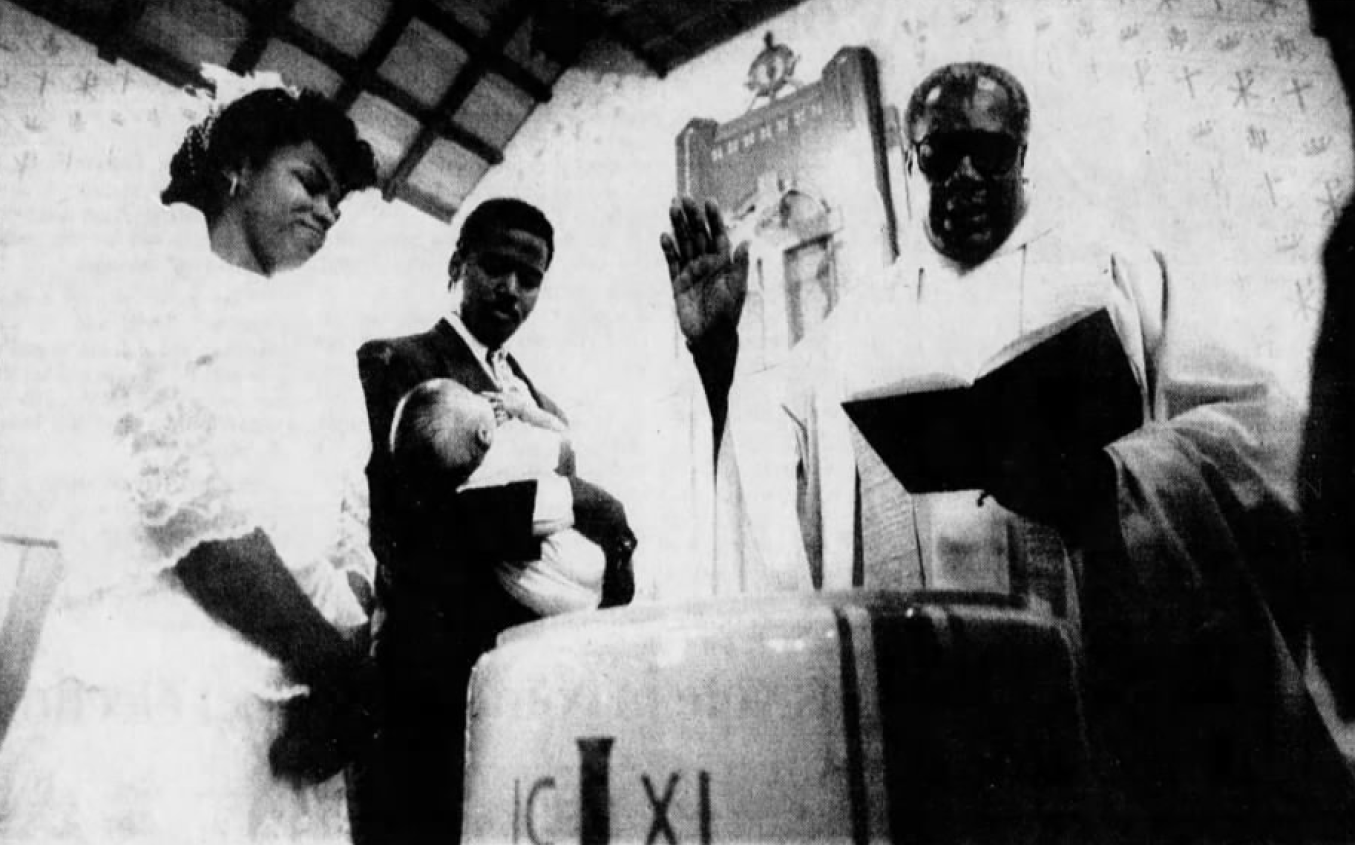
In September 1988, Cardinal Edmund Szoka, the archbishop of Detroit, announced via a closed-circuit television broadcast that the archdiocese would close dozens of inner-city parishes in Detroit within a year. Churches on the city’s predominantly Black east side would be disproportionately affected.
The announcement triggered an immediate outcry: parishioners met at Sacred Heart, Detroit's Black Catholic “mother church,” and held vigils outside locked churches; the Detroit Catholic Pastoral Alliance became the organizing hub of resistance; protestors marched up and down Woodward Avenue; and a few local residents planted mums outside the cardinal’s residence, one for each parish the archdiocese eventually closed.
In the second episode of "The City and the Cross," host and Commonweal Centennial Fellow Aaron Robertson chronicles the community organizers who coordinated these efforts, a journalist who covered the story, the Catholic priests caught between their vows of obedience and their commitment to Black parishioners, and the prominent Black Catholic leader—a former Black Panther—who had to deliver the news of the parish closures to the communities he faithfully tried to serve.
Featured Voices:
Walter Hurley, Cardinal Szoka's chief of staff, who oversaw the implementation of the closures;
Patricia Montemurri, a Detroit Free Press reporter who covered the Catholic Church in Detroit for decades;
Father Norm Thomas, the Lebanese American pastor of Sacred Heart Church and a co-founder of the Detroit Catholic Pastoral Alliance (DCPA), who became the public face of the fight against the closures;
Cathey DeSantis, a former nun who became one of the lead organizers of the DCPA;
Eric Blount, a Sacred Heart parishioner and minister who became an outspoken public voice against the archdiocese's plan;
Frances May, a Black laywoman who co-led the Alliance for Detroit Churches and directly challenged Cardinal Szoka's authority;
Wyatt Jones III, whose father Wyatt Jones Jr. delivered the news of the closures to the communities he had devoted his life to serving;
Michelle McKinney and her mother Jackie Mahome, who watched St. Agnes—the church where Jackie had built pioneering Black history programs—be merged out of existence;
Shirley Harris-Slaughter, a parishioner whose church was among the first to close, years before the larger wave;
Norah Duncan IV, a Black Catholic musician who watched the closures unfold from inside the archdiocesan chancery;
and Judith McNeeley, whose father Deacon Allen McNeeley built the Intercultural Formation Center at St. Bernard—one of the churches lost in 1989.
E3: Dots on a Map
Following the 1989 parish closures, the infrastructure that had supported Black Catholic leadership in Detroit was largely dismantled. Surviving parishes tried to rebuild community, while parishes that were merged struggled to forge new identities. Meanwhile, Cardinal Edmund Szoka, the archbishop who oversaw the closures, left the city for Rome to take a top Vatican finance post.
In the third and final episode of “The City and the Cross,” host and Commonweal Centennial Fellow Aaron Robertson weighs the total cost of the 1989 parish closures—not just the loss of buildings, but the erosion of the systems that once nurtured Black Catholic vocations. He tells the story of Fr. John McKenzie, a Black priest who tried to serve Detroit’s Black Catholic community with little institutional support, and whose struggle raises a pointed question for the Church today: Decades after 1989, how committed is the archdiocese to investing in Black Catholic communities?
Slowly, another question also starts to emerge: Did the Black Catholic Movement ultimately succeed, or did it fail? Robertson asks the people who lived through it.
Today, as the Detroit archdiocese undergoes another round of restructuring, Black Catholics are bracing for the worst, but they refuse to walk away from the spiritual centers they built and still call home.
Cast of Characters
The Parishioners
Marjorie Gabriel-Burrow (Episodes 1 and 3): Musician raised at St. Benedict the Moor who helped bring gospel into the Catholic sanctuary. Director of the committee that produced Lead Me, Guide Me, the African American Catholic hymnal (1987) and longtime music minister at St. Augustine–St. Monica.
Shirley Harris-Slaughter (Episodes 1 and 2): Member of Our Lady of Victory, the only Black parish in Detroit built from the ground up, who watched the archdiocese merge her church with another in 1982—years before the larger wave of closures in 1989.
Norah Duncan IV (Episodes 1, 2, and 3): Composer, educator, and church musician raised at Sacred Heart, Detroit’s “Black Catholic cathedral.” He later directed the Detroit archdiocesan worship office and watched the 1989 closures unfold from inside the chancery.
Jackie Mahome (Episodes 1 and 2): Church pianist and pioneer of Black history programming at St. Agnes in the 1960s, bringing Black musicians and spirituals into parish life.
Michelle McKinney (Episodes 1 and 2): Jackie Mahome’s daughter, whose childhood awakening at St. Agnes set her on a path away from the Catholic Church.
Judith McNeeley (Episodes 1, 2, and 3): Daughter of Deacon Allen McNeeley and a member of St. Bernard parish until its 1989 closure.
Eric Blount (Episode 2): Sacred Heart parishioner and minister mentored by Father Norm Thomas; active in Black Lay Catholics with a Vision.
Wyatt Jones III (Episodes 1 and 2): Son of Wyatt Jones Jr. who grew up in St. Cecilia parish.
The Movement Builders
Deacon Allen McNeeley (Episodes 1, 2, and 3) (historical figure): The first Black ordained deacon in the Archdiocese of Detroit (1969); founder of the Intercultural Formation Center and the Ministers of Service program at St. Bernard, which trained generations of clergy and Black lay leaders.
Dr. M. Shawn Copeland (Episodes 1 and 3): One of the world’s leading Catholic theologians, whose vocation began as a nun in Detroit; a key organizer in the early phases of the Black Catholic Movement.
Wyatt Jones Jr. (Episodes 1 and 2) (historical figure): Former Black Panther turned director of the Detroit archdiocese’s Office for Black Catholic Affairs. He became a public face of the 1989 closures.
Joseph Dulin (Episode 1) (historical figure): Principal of St. Martin de Porres High School who organized the 1970–1 protests against Catholic school closures in Detroit, including a thirteen-day occupation of the archdiocesan chancery.
The Priests
Fr. Tom Lumpkin (Episodes 1 and 3): Cofounder of the Detroit Catholic Pastoral Alliance (DCPA) and lifelong peace activist shaped by Vatican II.
Fr. Norm Thomas (Episodes 2 and 3) (heard in archival recordings): Beloved longtime pastor of Sacred Heart and cofounder of the DCPA. He led the public resistance to the 1989 closures.
Fr. Donald Archambault (Episode 1): White priest who taught at the Intercultural Formation Center and pastored the merged Presentation–Our Lady of Victory parish.
Fr. John McKenzie (Episode 3): A Black former Benedictine monk ordained as a priest in Detroit in 2019. After conflict with Archbishop Edward Weisenburger, he left the Roman Catholic Church in 2025.
Archdiocesan Leadership
Cardinal John Dearden (Episode 1) (heard in archival recordings): Detroit’s archbishop from 1958 to 1980 and one of Vatican II’s most progressive participants. He ordained the city’s pioneering Black clergy.
Cardinal Edmund Szoka (Episodes 1, 2, and 3) (historical figure): Dearden’s successor, an administrator known for his financial acumen. He ordered the unprecedented closure of more than thirty Detroit churches in 1989 and then departed for a top Vatican finance post the following year.
Bishop Walter Hurley (Episodes 2 and 3): Cardinal Szoka’s chief of staff.
The Organizers
Cathey DeSantis (Episodes 2 and 3): A white former nun and member of Sacred Heart. She became an organizer and eventually director of the DCPA after the 1989 closures.
Frances May (Episode 2) (heard in archival recordings): Black laywoman who co-led the Alliance for Detroit Churches and publicly criticized Cardinal Szoka for failing to consult Black Catholics about their own futures.
Steve Wasko (Episode 3): Secular Franciscan and member of a Detroit-area antiracism coalition formed after George Floyd’s murder. He has called for two archbishops to confront structural racism in the Archdiocese of Detroit ahead of the current restructuring (2025–7).
The Witnesses
Dr. Shannen Dee Williams (Episodes 1 and 3): Historian of Black Catholicism whose scholarship frames Detroit as the radical center of the national Black Catholic Movement.
Patricia Montemurri (Episodes 2 and 3): Former Detroit Free Press reporter who covered the Catholic Church starting in the late 1970s, chronicled the 1989 closures as they happened, and broke the news of Cardinal Szoka’s Vatican appointment.
Dr. M. Shawn Copeland, a former nun from Detroit, now one of the world’s leading Catholic theologians;
Fr. Tom Lumpkin, a founding member of the Detroit Catholic Pastoral Alliance (DCPA);
Fr. Norm Thomas, the longtime pastor of Sacred Heart and a cofounder of the DCPA who led the public resistance to the 1989 closures (archival);
Fr. John McKenzie, a Black former Benedictine monk ordained a priest in Detroit in 2019, whose path eventually led him out of the Roman Catholic Church;
Bishop Walter Hurley, Cardinal Edmund Szoka’s chief of staff;
Cathey DeSantis, a nun and member of Sacred Heart who became an organizer and eventually director of the DCPA;
Steve Wasko, a Secular Franciscan and member of a Detroit-area antiracism coalition that formed in the wake of George Floyd’s murder;
Dr. Shannen Dee Williams, a historian of Black Catholicism whose scholarship frames Detroit as the radical center of the national Black Catholic Movement;
and Patricia Montemurri, a former Detroit Free Press reporter who chronicled the 1989 closures and broke the news of Szoka’s Vatican appointment.
Featured Voices:
Marjorie Gabriel-Burrow, a musician who helped bring Black musical styles into Catholic Mass;
Norah Duncan IV, a nationally acclaimed composer who watched the 1989 closures unfold from inside the archdiocesan chancery;
Judith McNeeley, the daughter of Deacon Allen McNeeley, who was a member of St. Bernard parish until its 1989 closure;